The commercial marine industry

Weather and routing decision support for commercial marine operations

Supporting operational planning, safety, and efficiency under uncertain weather conditions.

the global context

Weather-related maritime challenges

Weather remains one of the most critical  and least structurally integrated factors in maritime decision-making.

Despite its direct impact on safety, fuel consumption, schedules, and compliance, weather is still often treated as external information rather than a strategic operational variable.

Marine Weather Intelligence was created to help maritime stakeholders reintegrate weather into operational and strategic decisions, through clear, expert-led decision support.

shared challenges

Putting weather back at the core of maritime operations

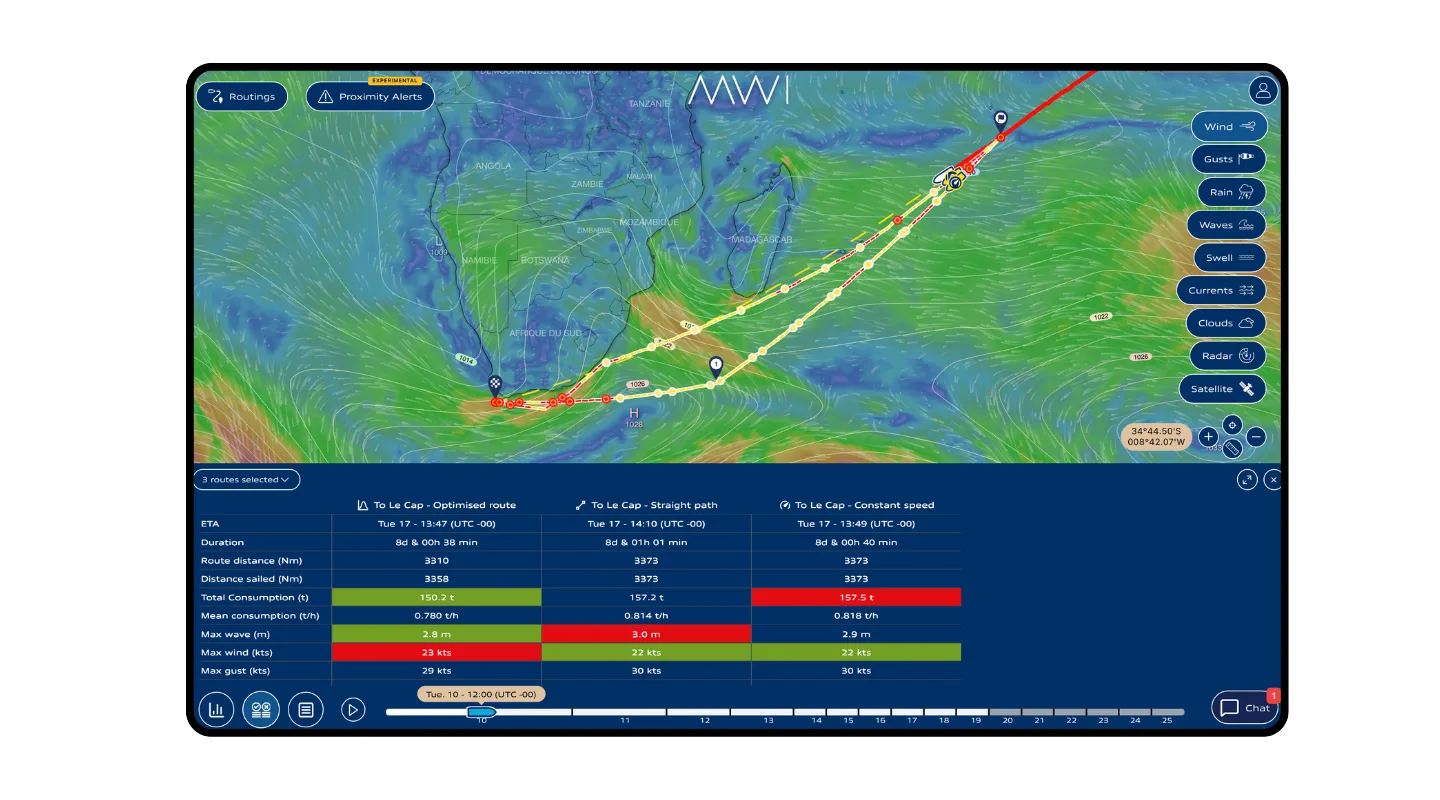
Marine Weather Intelligence supports commercial marine operators with decision-ready weather intelligence, combining advanced routing, vessel-specific performance, quantified risks, and expert support designed for both ship and shore teams.

Weather-driven decisions requires weather expertise

  • Merchant navy officers receive limited formal training in meteorology: 22 hours in 5 years.

  • Weather interpretation is often left to experience rather than quantified analysis.

  • Existing tools are either too complex or too generic to support operational decisions.

Conflicting operational objectives

  • Reduce fuel consumption and emissions.

  • Maintain reliable ETAs.

  • Protect vessel, cargo, and crew.

  • Justify decisions to shore management and external stakeholders.

Increasing operational complexity

  • Weather volatility and extreme events.

  • Regulatory pressure (emissions, reporting, safety).

  • Growing need for traceability and decision transparency.

cargo, tanker, bulk...

Shipping & Fleet operations

Operational context

Voyage planning and execution in shipping require continuous trade-offs between route length, weather exposure, fuel consumption, and arrival time.
Weather-related decisions affect not only performance but also long-term vessel integrity and compliance metrics.

Key challenges

These challenges are coupled with international demands for early risks anticipation and environmental compliance.

  • Sustainability

    Managing fuel consumption under variable weather conditions.

  • Just-in-time

    Maintaining realistic and reliable ETAs.

  • Risk assessment

    Understanding weather-related risks beyond simple avoidance.

  • Communication

    Aligning decisions between the bridge and shore-based teams.

complex maritime operations

Heavy lift, special transport & tug operations

Operational context

Special transport and towing operations are often constrained by narrow weather tolerances.
Vessel motions, wave-induced loads, and parametric rolling can become limiting factors well before extreme conditions are reached.

Key challenges

tugboat

The role of Marine Weather Intelligence

  • Risk-oriented routing focused on vessel motions and stability.

  • Indicators addressing parametric roll and dynamic loads.

  • Comparative scenario analysis prior to commitment.

  • Expert-assisted interpretation for complex operations.

ferries and cruising ships

Cruise & passenger vessels

Operational context

Passenger vessels face additional constraints related to comfort, schedule integrity, and public exposure.
Weather-related decisions have direct implications for safety perception and operational continuity.

Key challenges

  • Comfort

    Managing vessel motions affecting passenger comfort.

  • Itinerary

    Maintaining itinerary reliable

  • Anticipation

    Anticipating conditions that may affect onboard experience.

CruisingBoat

The role of Marine Weather Intelligence

  • Weather-aware routing focused on comfort and safety

  • Anticipation of disruptive weather events

  • Clear alerts and guidance for itinerary adjustments

  • Fleet-level visibility when operating multiple vessels

A shared technological foundation

All these activities rely on the same MWI core technology:
AI-driven data processing applied across the platform, probabilistic weather analysis, adaptive vessel performance modelling, and human expert judgement.

This foundation enables MWI to support multiple maritime activities today, while progressively tailoring configurations and interfaces to each sector.

limitations

About responsibilities

MWI does not aim to replace operational responsibility or existing bridge systems.
It provides clear, expert-led decision support to help maritime professionals navigate weather complexity with greater confidence and consistency.

they trust us

A few customer references

EXPLORE MWI SOLUTIONS

Discuss your operational context with MWI