ESA Kick-Start Project Conclusion – HWZSea
Marine Weather Intelligence has successfully completed its ESA Kick-Start feasibility study focused on HWZSea, an advanced maritime early-warning concept designed to enhance operational safety at sea.
Supported by the European Space Agency, the project aimed to assess how space-based data could strengthen short-term hazard anticipation in demanding offshore and shipping environments.
What Was the Goal of the Project?
The primary objective of the HWZSea study was to evaluate the feasibility of a next-generation maritime warning service capable of improving the detection and anticipation of hazardous weather phenomena at sea.
The project focused on:
Enhancing short-term risk anticipation for vessels
Reducing exposure to sudden, high-impact weather events
Supporting safer operational decision-making
Assessing the technical and commercial viability of a scalable early-warning service
The study specifically addressed meteorological situations that are difficult to anticipate with traditional forecasting approaches but can have significant operational and financial consequences.
Who Is It Designed For?
HWZSea targets high-value maritime operations where safety, reliability, and timing are critical.
The service is designed for:
Commercial shipping operators
Offshore energy companies
Complex maritime transport projects
Cruise and ferry operators
Marine warranty surveyors and insurers
In these sectors, operational decisions must balance safety constraints, regulatory requirements, schedule commitments, and economic performance. Enhanced situational awareness directly supports these objectives.
How Does It Work?
The system explored during the feasibility phase combines multiple data sources into a unified maritime decision-support framework. Various inputs are analysed to generate vessel-specific hazard insights and contextualised alerts. The system does not simply broadcast generic warnings; instead, it evaluates exposure relative to each vessel’s location and operational profile.
The objective is to provide actionable, operationally relevant information, enabling captains, fleet managers, and stakeholders to anticipate risks rather than react to them.
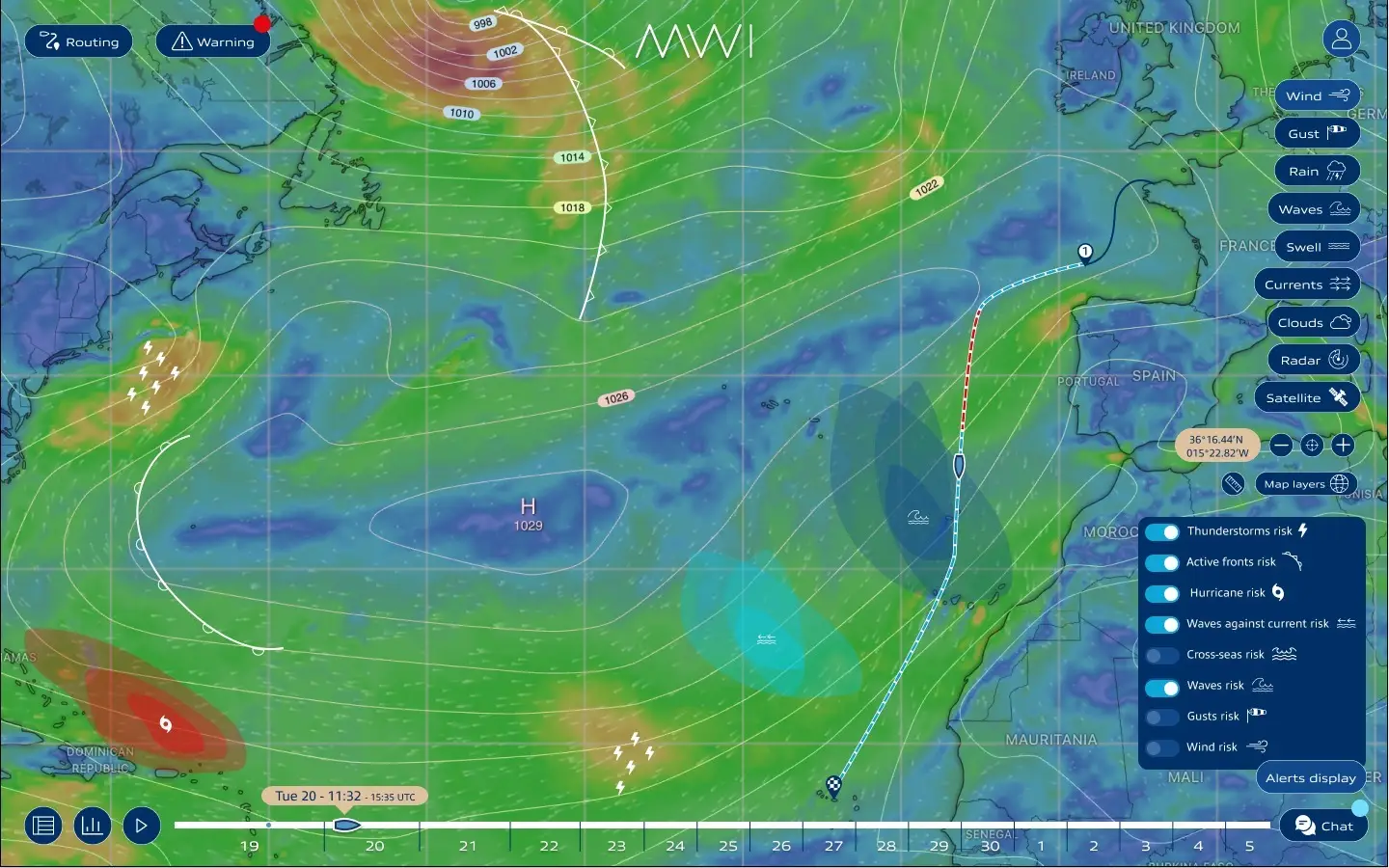
Some examples of hazardous weather zones:
The Added Value of Space Data
Satellite data provides several key advantages:
Wide-area, continuous monitoring over oceanic regions
High temporal resolution for near-real-time tracking
Independent observation capabilities beyond ground-based networks
By leveraging space-enabled assets, the project demonstrated how enhanced atmospheric monitoring can strengthen maritime early-warning capacity, particularly in regions with limited observational infrastructure.
The collaboration with the European Space Agency ensured:
Access to high-quality satellite data streams
Technical validation within a structured innovation framework
Alignment with broader European space-based safety initiatives
This partnership reinforced the scientific robustness and strategic relevance of the project.
What’s Next?
The feasibility study confirmed the technical relevance and operational interest of the HWZSea concept. The completion of the ESA Kick-Start programme marks a significant milestone in MWI’s R&D roadmap. It strengthens the company’s ambition to deliver advanced, science-driven maritime decision-support solutions that combine meteorological expertise, operational understanding, and space-enabled innovation.
HWZSea represents a foundational step toward more resilient, data-enhanced maritime operations in an increasingly complex regulatory and environmental landscape.