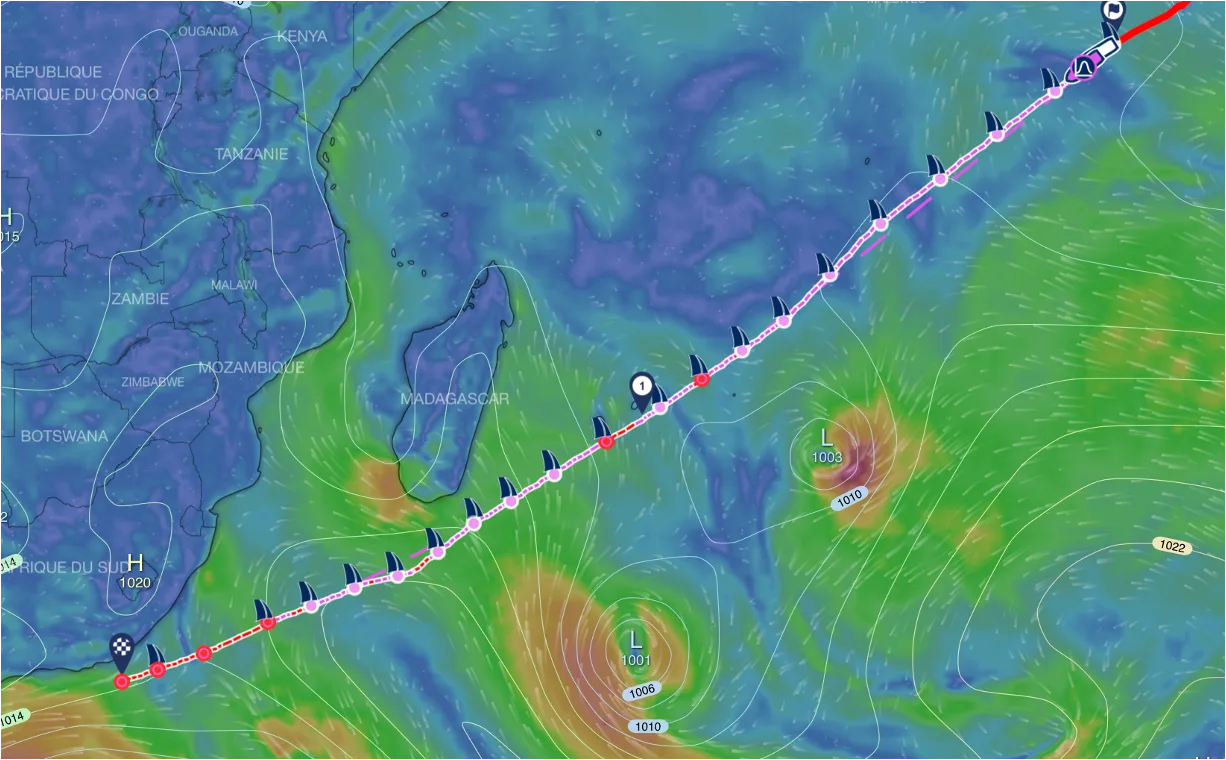
In maritime operations, it is commonly assumed that reducing vessel speed lowers fuel consumption. While true in stable conditions, real-world voyages are shaped by evolving weather and sea state, and the relationship between speed and fuel use is not always what it seems.
The hidden efficiency of weather routing
What if going faster could actually save fuel?
In maritime operations, it is commonly assumed that reducing vessel speed lowers fuel consumption. While true in stable conditions, real-world voyages are shaped by evolving weather and sea state.
As a result, the relationship between speed and fuel use is not linear, and in some cases, arriving earlier can reduce total fuel consumption.
Why fuel doesn’t scale with speed alone
Naval architecture gives slow steaming its intuitive appeal: calm-water resistance rises roughly with the cube of speed, so shaving a few knots off a passage plan looks like an easy win on paper. But calm-water resistance is only one term in the equation.
The other term is added resistance: the extra drag imposed by wind, waves, and swell on top of the hull’s baseline resistance. Head seas and headwinds can add a significant share of total resistance at a given speed, and that share grows sharply as sea state deteriorates. Two vessels making the same speed through the water can burn very different amounts of fuel depending on what they’re pushing through.
This is why the “optimal” speed is not a fixed number. It shifts hour by hour with the weather a vessel is actually sailing into, which is a function of both the forecast and of when the vessel arrives at each point on the route.
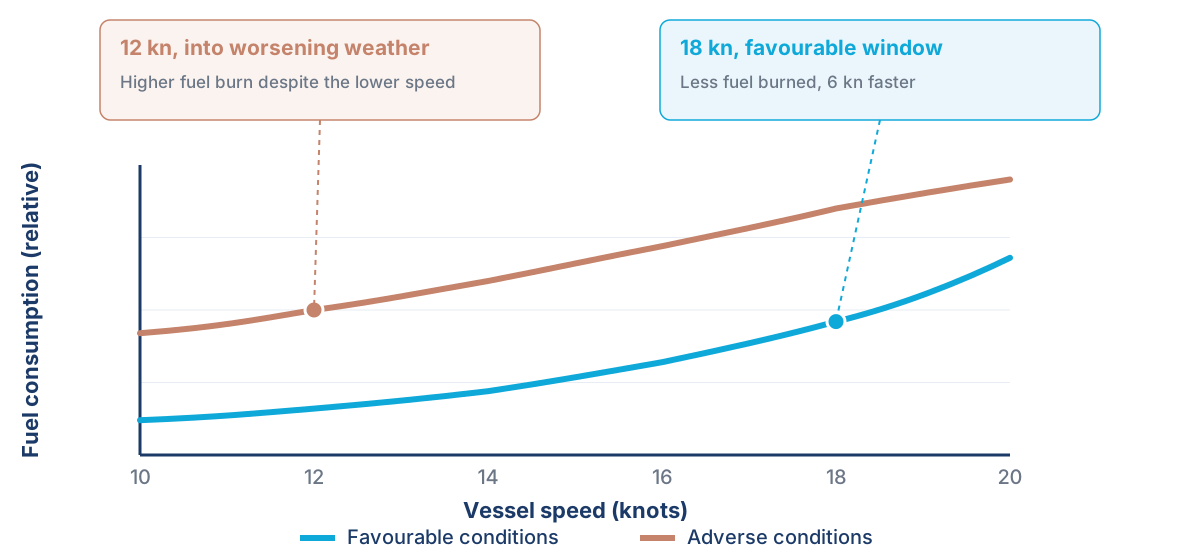
The chart above illustrates the effect: a vessel making 12 knots into worsening weather can burn more fuel than the same vessel making 18 knots through a favourable window, because added resistance, not speed, is doing most of the work.
The limits of slow steaming
Slow steaming is based on a simple principle: lower speed reduces resistance and fuel use.
However, it does not account for how conditions evolve over time. Wind systems shift, waves build, and routes that seem efficient initially can become increasingly penalising.
A later arrival can mean sailing directly into stronger headwinds and higher waves, significantly increasing resistance and energy demand. Reducing engine load without accounting for that exposure only guarantees a longer time at sea, not lower total consumption.
A real hybrid vessel scenario
Two routing strategies illustrate this effect:
Scenario 1: slower speed, later arrival
- Required time of arrival: Saturday 18th at 12:00
- Fuel consumption: 210 tonnes
By reducing speed, the vessel extended its time at sea and reached the final part of the route under more adverse wind and wave conditions. Stronger headwinds and increased wave height led to higher resistance, forcing greater energy use, despite the lower speed.
Scenario 2: optimised timing, earlier arrival
- Estimated time of arrival: 17 April at 21:30
- Fuel consumption: 140 tonnes
Slightly higher engine use early in the voyage allowed the vessel to pass through the same areas before conditions deteriorated.
Result: 33% less fuel consumption.
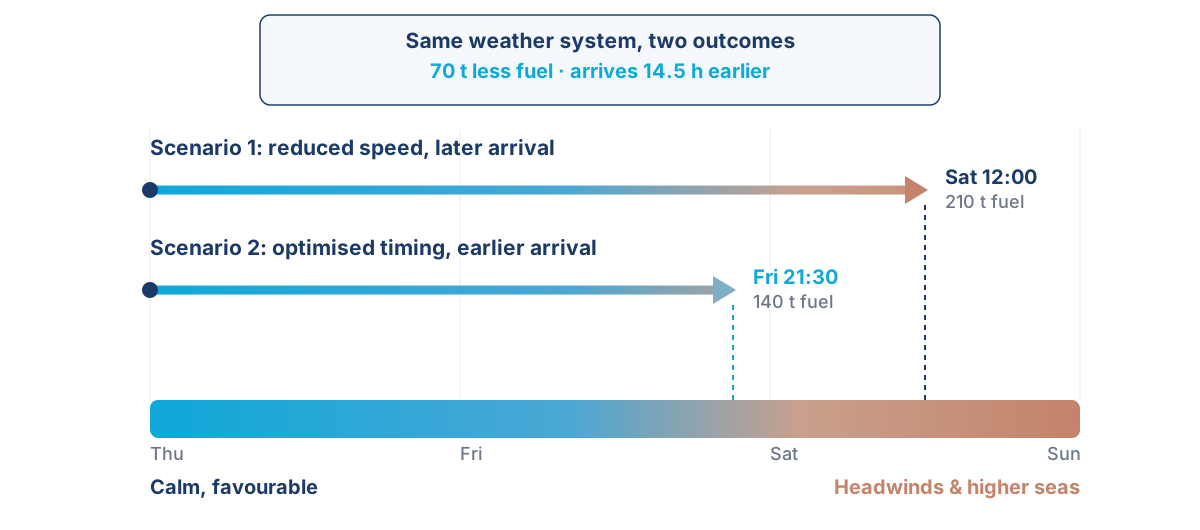
Both vessels sail through the same weather system. The difference is entirely a function of timing: Scenario 2 reaches the exposed section of the route while conditions are still manageable, while Scenario 1’s lower speed leaves it exposed to the same area after the weather has deteriorated further.
Why timing matters
Fuel efficiency depends not only on speed, but on exposure to environmental conditions over time.
By adjusting timing, the vessel:
- Avoided peak adverse wind and wave conditions
- Reduced added resistance from head seas
- Benefited from a more favourable weather window
The lesson generalises beyond this one voyage: a fixed speed or a fixed slow-steaming rule optimises for the average case, not the case at hand. The same route, sailed a few hours earlier or later, or a few knots faster or slower, can carry a materially different fuel bill because it carries a different weather exposure.
How Marine Weather Intelligence finds the right speed profile
Making this call in practice means continuously weighing two things against each other: the forecast conditions along every remaining segment of the route, and the fuel cost of the resistance those conditions will add at a given speed and heading.
Marine Weather Intelligence’s routing approach:
- Tracks the full route, not just the next waypoint, so a speed change early in the voyage is evaluated against the conditions it produces exposure to later on, not just its immediate fuel draw.
- Re-optimises as the forecast updates, adjusting the recommended speed profile as wind, wave, and current forecasts evolve rather than locking in a single plan at departure.
- Weighs schedule constraints alongside fuel, so a required time of arrival, a tide window, or a berth slot is treated as a hard constraint the optimisation works within, not an afterthought.
This is what allowed Scenario 2 to be identified as the better option: not a rule of thumb about speed, but a route-length comparison of two complete fuel profiles under the same evolving weather.
Practical takeaways for operators
- Treat “slow steaming” as a starting assumption to test, not a fixed rule, especially on routes exposed to variable wind and sea state.
- Compare full-route fuel burn across candidate speed profiles rather than judging a plan by its instantaneous engine load.
- Reassess timing and speed as the forecast updates, since a plan optimised at departure can stop being optimal well before arrival.
Marine Weather Intelligence enables operators to anticipate changing ocean conditions and optimise routing to minimise both fuel consumption and weather exposure.