The hidden efficiency of weather routing in hybrid vessel operations
What if going faster could actually save fuel?
In maritime operations, it’s commonly assumed that reducing vessel speed lowers fuel consumption. While true in stable conditions, real-world voyages are shaped by evolving weather and sea state.
As a result, the relationship between speed and fuel use is not linear — and in some cases, arriving earlier can reduce total fuel consumption.
The limits of slow steaming
Slow steaming is based on a simple principle: lower speed reduces resistance and fuel use.
However, it does not account for how conditions evolve over time. Wind systems shift, waves build, and routes that seem efficient initially can become increasingly penalising.
A later arrival can mean sailing directly into stronger headwinds and higher waves, significantly increasing resistance and energy demand.
A real hybrid vessel scenario
Two routing strategies illustrate this effect:
Scenario 1: Slower speed, later arrival
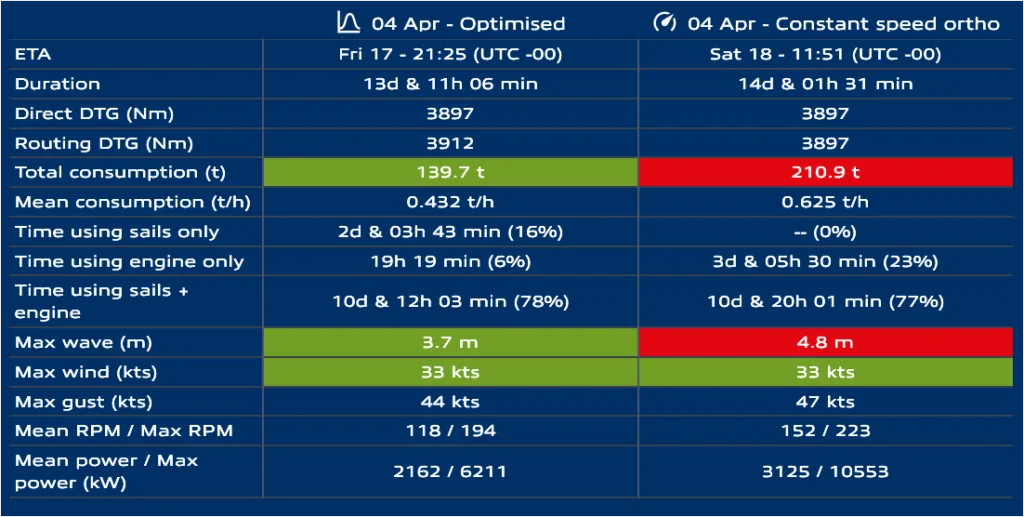
- RTA (required time arrival): Saturday 18th at 12:00
- Fuel consumption: 210 tons
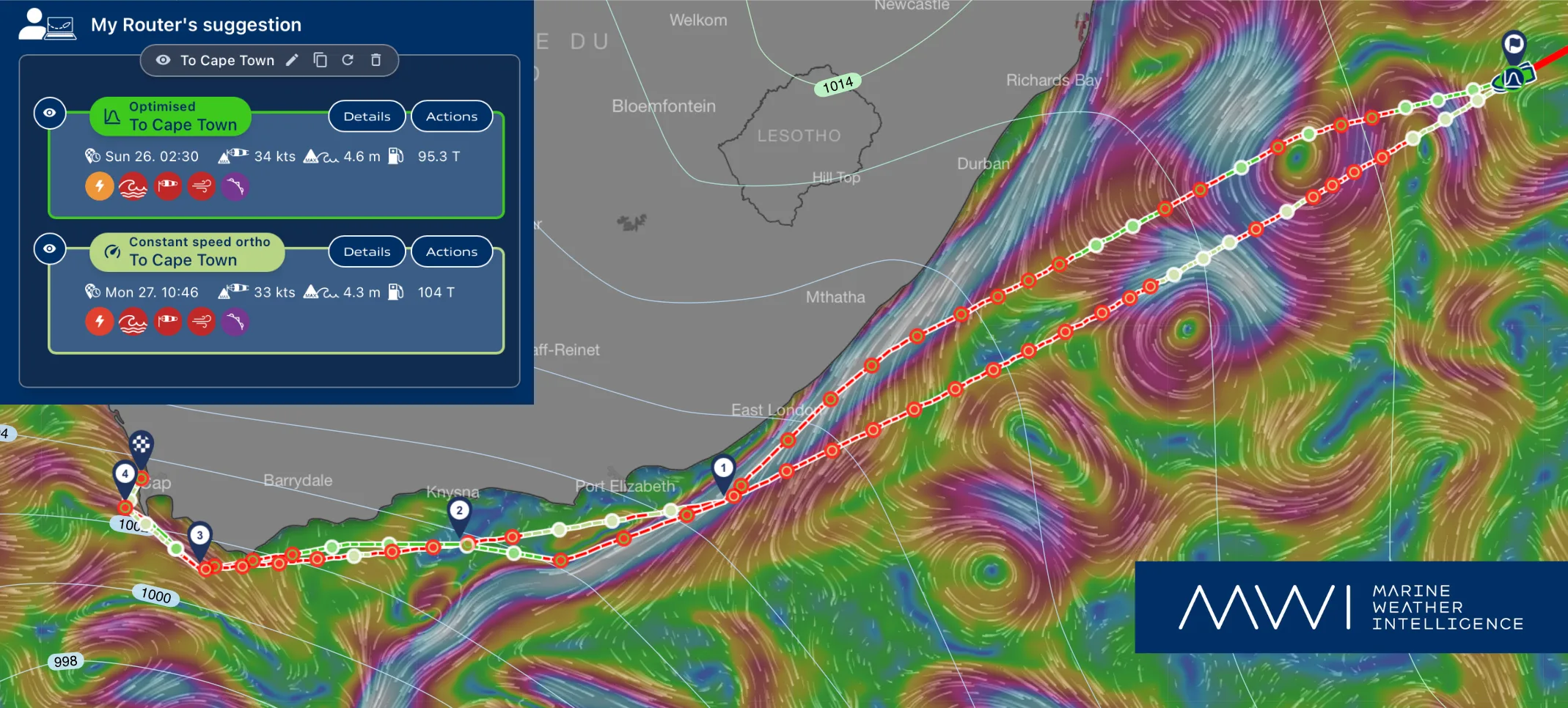
By reducing speed, the vessel extended its time at sea and reached the final part of the route under more adverse wind and wave conditions.
Stronger headwinds and increased wave height led to higher resistance, forcing greater energy use — despite the lower speed.
Scenario 2: Optimised timing, earlier arrival
- ETA (Estimated time arrival): 17 April at 21:30
- Fuel consumption: 140 tons
Here, slightly higher engine use early in the voyage allowed the vessel to pass through the same areas before conditions deteriorated.
Result: 33% less fuel consumption
Why timing matters
Fuel efficiency depends not only on speed, but on exposure to environmental conditions over time.
By adjusting timing, the vessel:
- Avoided peak adverse wind and wave conditions
- Reduced added resistance from head seas
- Benefited from a more favourable weather window
At Marine Weather Intelligence, we enable operators to anticipate changing ocean conditions and optimise routing and speed to minimise fuel consumption and
weather exposure.